Skip to content

About the Institute


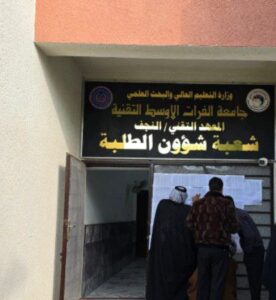
The institute was established in 1978 in a small building in the city of Kufa, initially comprising only two scientific departments. In 1982, the institute moved to the city of Najaf Al-Ashraf, on the road connecting Najaf city to Abu Sakhir district. The institute has witnessed continuous development over the following years and currently includes 19 departments and 4 branches, distributed across four main specializations: technological, administrative, artistic, and medical.


First: Administrative Departments
1- Accounting Techniques
2- Legal Administration Techniques
3- Tourism Techniques

Second: Engineering Departments
1- Computer Networks and Software Techniques, which includes two branches: Computer Networks and Software Branch, Artificial Intelligence Branch
2- Electrical Techniques, which includes two branches: Power Electricity Techniques Branch, Renewable Energy Techniques Branch
3- Electronics and Communications Techniques, which includes two branches: Electronics and Communications Techniques Branch, Cybersecurity Branch
4- Civil Engineering Techniques, which includes two branches: Construction and Building Branch, Surveying Techniques Branch
5- Petroleum Refining Techniques
6- Medical Devices Maintenance Techniques
7- Aviation Techniques
8- Mechanical Techniques
9- Power Mechanics Techniques

Third: Arts Departments
1- Architectural Design and Decoration Techniques

Fourth: Medical Departments
1- Beauty and Laser Techniques
2- Optometry Techniques
3- Dental Manufacturing Techniques
4- Dental Prevention Techniques
5- Forensic Evidence Techniques
6- Health Administration Techniques
*]:pointer-events-auto scroll-mt-[calc(var(--header-height)+min(200px,max(70px,20svh)))]" dir="auto" data-turn-id="request-WEB:83dcd8d6-2798-4c21-a8ee-7a1cdf24ecd0-5" data-testid="conversation-turn-12" data-scroll-anchor="true" data-turn="assistant">


To have the institute occupy an advanced position locally, regionally, and across the Arab world, and to strive internationally, by deepening the concepts of technical education in particular, and higher education in general, among youth and the community. This aims to establish an informed base for this path of higher education for those seeking to acquire the best skills and knowledge in technological and administrative specializations, keeping pace with modern scientific developments in the technical education program, guiding scientific research, and utilizing it to serve the community and various projects


*]:pointer-events-auto scroll-mt-[calc(var(--header-height)+min(200px,max(70px,20svh)))]" dir="auto" data-turn-id="request-WEB:83dcd8d6-2798-4c21-a8ee-7a1cdf24ecd0-7" data-testid="conversation-turn-16" data-scroll-anchor="true" data-turn="assistant">


To graduate qualified technical personnel in all specialties to meet the demands of the labor market and support the path of technological development by continuously improving curricula both theoretically and practically, and by using the latest teaching methods.


To prepare qualified technical personnel in various technical, administrative, and applied arts fields, equipped with the knowledge and skills necessary to contribute to the reconstruction process.

1- Strengthen the role and effectiveness of technical education within the knowledge-based society and educational system.
2- Adopt practical pathways, systems, and curricula capable of supporting the technical workforce structure in the country.
3- Continuously update theoretical curricula and scientific applications.
4- Expand the scope of scientific and practical activities in all directions—individually, objectively, and socially.
5- Establish cooperation, communication, and interaction between the institute and different segments of society, as well as with corresponding local and international entities.

Organizational Structure

It is a system that illustrates the distribution of tasks and responsibilities within the institution, showing the relationships between departments, administrations, and staff, with the aim of organizing work and achieving coordination and efficiency in performance.
More

Work Structure of a Faculty Member

It includes teaching, supervising research, participating in academic committees, developing curricula, and contributing to scientific and administrative activities that serve the institution and the students.
More

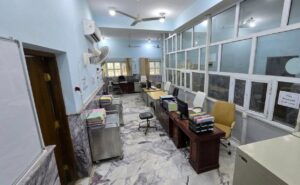
The Role of Universities in Community Development and Advancement

The role of universities: preparing qualified personnel, conducting scientific research, and supporting community development.
More

Photo Gallery

view all