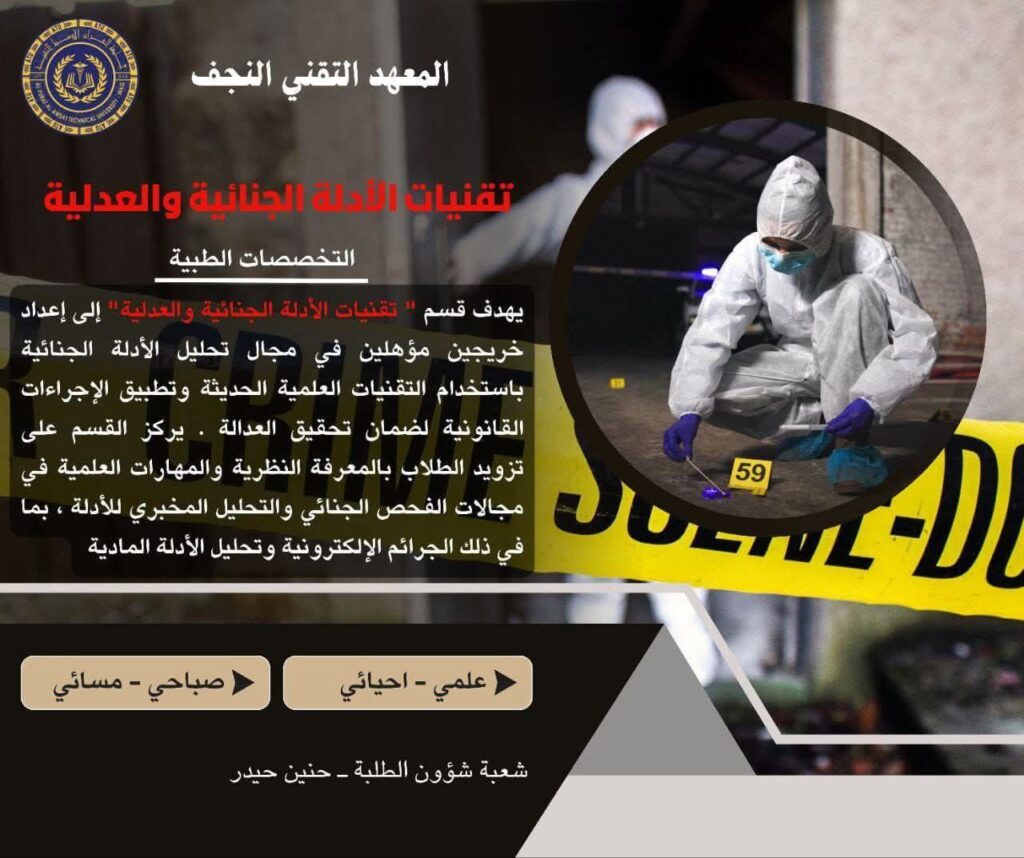

The Najaf Technical Institute is pleased to announce the opening of the Forensic and Legal Evidence Technologies Department for middle school graduates. This department is the first of its kind in technical education and aims to prepare specialized and scientifically and practically qualified personnel to work in the field of forensic and legal evidence, which is witnessing rapid development and a pressing need in the job market.
Why choose the Forensic and Legal Evidence Technologies Department?
- The department features a comprehensive curriculum that focuses on providing students with the necessary knowledge and skills in vital and integrated areas:
- Medical and Forensic Analysis Techniques: Students learn the latest techniques used in analyzing biological and forensic samples, such as DNA, fingerprints, and toxic substances, and how to accurately interpret the results.
- Legal and Criminal Investigation: Students receive intensive training in the principles of criminal and legal investigation, including evidence collection, crime scene preservation, and technical report preparation.
- Advanced Laboratories: The department includes modern laboratories equipped with the latest equipment and technologies, ensuring high-level practical training.
Job Descriptions for Department Graduates
- Students in this department graduate with a unique set of skills that qualify them to work in various relevant entities. They possess all the skills required by the Criminal Evidence and Forensic Sciences Department, including, but not limited to:
- Ability to Collect and Preserve Forensic Evidence: Graduates are skilled at handling crime scenes, documenting evidence, and collecting it using scientific methods that ensure its integrity and legal value.
- Analysis of Forensic Samples: Master the use of laboratory techniques to analyze various samples such as blood, tissue, fibers, ballistics, and explosives.
- Writing Technical and Legal Reports: Ability to prepare accurate and detailed technical reports that comply with legal standards and present them as evidence in court.
- Assistance in Criminal Investigations: Effectively contribute to the progress of investigations by providing technical expertise in the field of forensic evidence.
- Working with Criminal Database Programs: Use specialized systems and programs to analyze and classify criminal data. 7. Application of forensic principles: Understanding the foundations of forensic medicine and how they relate to criminal investigations.
- Working within a multidisciplinary team: The ability to cooperate and coordinate with investigators, judges, and physicians within the criminal justice framework.
A comprehensive educational and training program
The diploma program in this department extends over two academic years and includes:
- Intensive summer training: Provides students with the opportunity to apply theoretical knowledge in a real-world work environment.
- Specialized workshops and seminars: To enhance practical skills and keep up with the latest developments in the field.
- Scientific visits: To criminal institutions and specialized laboratories to connect theory with practice.
- “Criminal plays”: Practical activities that simulate real-life crime scenarios to develop students’ investigative and analytical skills.
Students in this department graduate with the “charisma of a criminal investigator and forensic doctor,” in addition to possessing advanced skills that help them excel in a job market that is in dire need of their expertise. We invite ambitious middle school graduates to join this promising department and contribute to strengthening the justice system in Iraq.